
































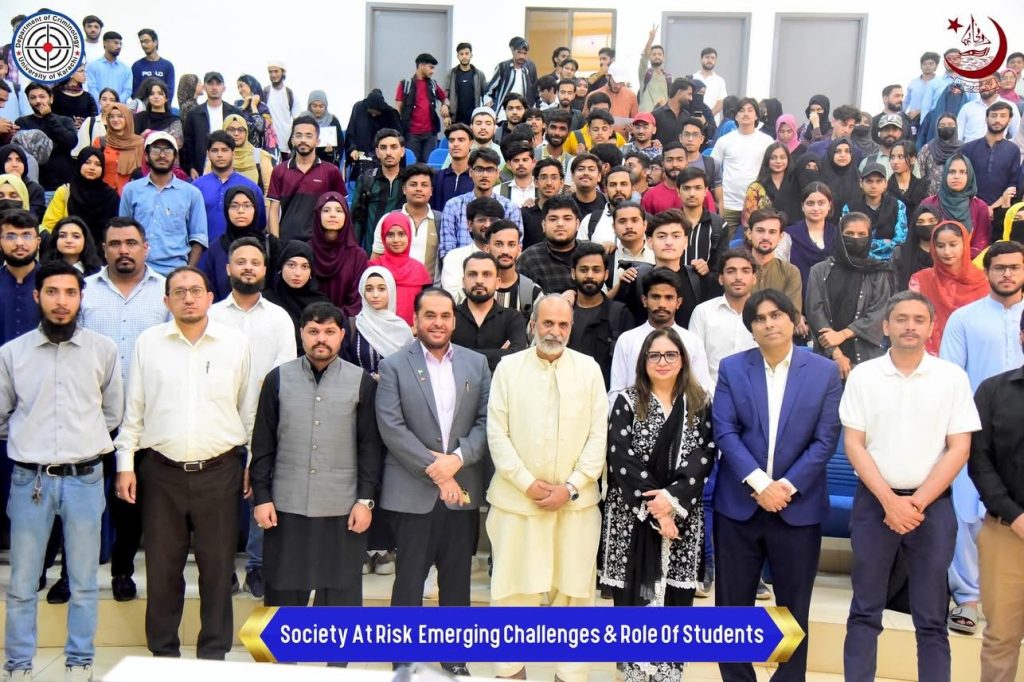
Renowned Media Person and Forensic Expert Dr. Umair Haroon delivered a compelling address at a thought-provoking seminar titled “Society at Risk: Emerging Challenges and the Role of Students”, organized by the Department of Criminology at University of Karachi under the leadership of Professor Dr. Naima Saeed.
The event was held at the KU School of Law Auditorium and was graced by the Vice Chancellor of University of Karachi, Khalid Mehmood Iraqi, who attended as the Chief Guest. Faculty members, researchers, and a large number of students participated in the seminar, reflecting keen interest in contemporary criminological discourse.




In his keynote address, Dr. Umair Haroon spoke extensively on the evolution of human understanding of crime, tracing its conceptual development from primitive notions of revenge and retribution to modern frameworks grounded in law, sociology, and scientific inquiry. He emphasized that crime has never been a static concept; rather, its definitions have shifted across civilizations and historical eras, shaped by cultural, political, and legal transformations.
Highlighting the academic foundations of the discipline, Dr. Umair Haroon described criminology as the parent branch of forensic sciences. He explained that while forensic science provides the technical tools and methodologies for investigation, it is criminology that offers the theoretical framework to understand criminal behavior, causation, and societal impact.
Underscoring the importance of objectivity in the justice system, he asserted that scientific evidence remains supreme in modern legal processes. He said that he sees two great milestones in recent human history: one in 1953, when James Watson and Francis Crick discovered the structure of DNA, and the second when the Human Genome Project was completed.
Dr. Umair Haroon also reflected on the concept of justice from an Islamic perspective, describing the Qur’anic aayat on justice as a timeless and universal articulation of fairness, accountability, and moral responsibility. He remarked that the Qur’anic principle of standing firmly for justice even if against oneself or one’s kin remains one of the most powerful examples of an equitable legal and moral framework.
Concluding his address, Dr. Haroon observed that while the definitions of crime have changed throughout history, tyranny has remained a constant reality. “Crime may be redefined by societies, but oppression has always carried the same face,” he stated.
He ended his powerful speech with a moving couplet:
حسین تم نہیں رہے تمھارا گھر نہیں رہا
مگر تمھارے بعد ظالموں کا ڈر نہیں رہا